About REFOOTURE:
Rethinking how we grow, share and govern ecosystems, livelihoods, food and communities
REFOOTURE is all about reimagining how we grow, share, and govern ecosystems, livelihoods, food and communities – starting from the ground up. It is a collaborative initiative that aims to build Regenerative and Inclusive Food Systems (RIFS) that restore ecosystems, empower people in vulnerable situations, and create fair, lasting livelihoods.
The cornerstone of our approach is Collaborate to Regenerate (C2R), a participatory method that invites:
- Local communities, especially those facing disadvantage,
- Nature, as a living system with its own rhythms and needs,
- And powerholders, such as local governments or institutions.
By bringing these three voices into conversation and action, C2R creates the conditions for win-win-win outcomes: healthy ecosystems, resilient communities, and more inclusive governance.
How we work: from vision to action
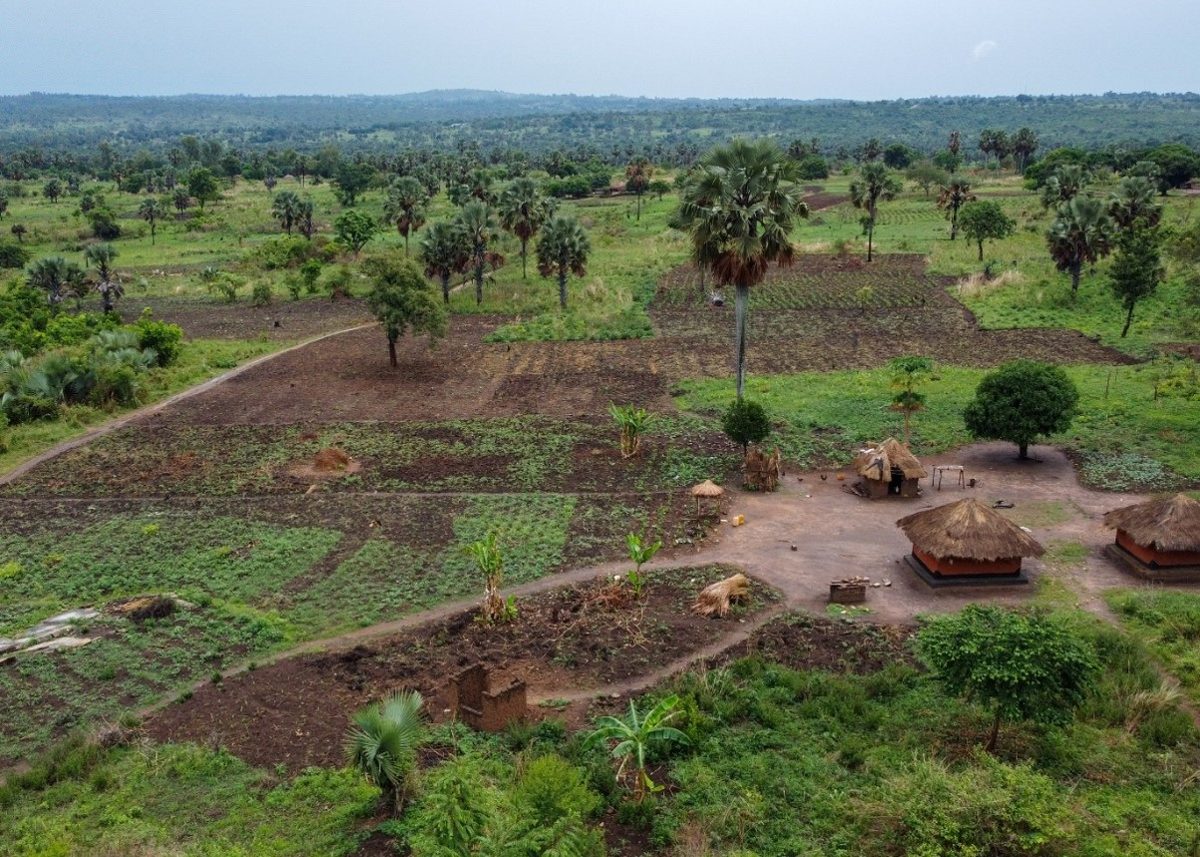
In three East African regions — Arilo (Uganda), Menengai (Kenya), and Wanja Kerssa (Ethiopia) — we are co-developing context-specific solutions through local Food System Innovation Platforms (FSIPs). These FSIPs are long-lasting collaborations that drive transformation
These platforms act as Living Labs, where farmers, researchers, start-ups, and local leaders:
- Experiment with agroecological practices and inclusive business models
- Develop community-led agendas for change
- And build long-term capacity for transformation
FSIPs creates a structured yet flexible environment to prototype, test, and scale what works — rooted in place, people, and purpose.
What are Regenerative and Inclusive Food Systems (RIFS)?
Regenerative and Inclusive Food Systems (RIFS) are food systems that place equal value on ecological integrity, community well-being, and social equity. They are designed to promote healthy ecosystems, resilient livelihoods, access to nutritious food, and caring communities.
They are not one-size-fits-all models, but emerge through dialogue, experimentation, and learning — supported by approaches like the Joint Agenda for Change (JA4C).
Our mission
REFOOTURE believes the future of food must be built with communities and for the landscapes they depend on.
Its support that transformation by cultivating change that’s rooted in local realities and aligned with a global vision for just and sustainable food systems.
Our principles
REFOOTURE is guided by five core principles that shape the journey toward Regenerative and Inclusive Food Systems (RIFS). They remind us that transformation must be rooted in real places, inclusive of diverse voices, and always responsive to both people and nature. Together, they form a living framework for change.
🌍 Sense of place and purpose – Start with people and their landscapes
Transformation begins where people live and work. By caring for communities and ecosystems, we give direction and meaning to the change we seek.
🌱 Socio-ecological design – Work with nature, honour local knowledge
Every innovation should grow from local needs, respect indigenous knowledge, and work with nature to strengthen collective well-being.
🤝 Building connections – Stronger together, with each other and with nature
Strong relationships (between people, communities, and nature) create the resilience needed for food systems to thrive in the face of change.
⚖️ Just and inclusive transitions – Fairness and voice for all
Fairness and equity are non-negotiable. RIFS ensure that marginalized groups have a voice and that natural systems, which sustain all life, are protected.
🔁 Design for renewal – Keep learning, adapting, regenerating
Change is never “done.” Regenerative systems evolve through continuous learning, adapting, and rebuilding, ensuring lasting benefits for both people and planet.

These principles guide every step of our work, from village-level pilots to regional platforms, helping us grow food systems that are fair, resilient, and regenerative.
Our themes
Regenerative and Inclusive Food Systems (RIFS)
What if food systems could feed people well, restore nature and leave no one behind, all at once? That is what Regenerative and Inclusive Food Systems (RIFS) aim to do. They go beyond sustaining what we have and work to regenerate it. RIFS pursue four connected goals: food and nutrition security, resilient livelihoods, healthy ecosystems, and social equity and caring communities.
RIFS are not a blueprint. In Kenya, Uganda and Ethiopia, communities shape them place by place, guided by five principles: sense of place, working with nature, strong connections, fairness for all, and continuous renewal. Healthy soils are essential to working with nature, supporting biodiversity, water retention, nutrient cycling and resilient food production. Farmers, entrepreneurs, researchers and local institutions all have a part to play.
Food Systems Innovation Platforms (FSIPs)
How can local innovation grow into lasting change? FSIPs connect communities, researchers, government and funders who usually work apart. They don’t lead the change. They support community-led innovation, link needs to resources through “Ask and Offer” sessions, and help successful approaches spread. FSIPs are still developing, and we share what we learn.
Place-Based Innovation with C2R
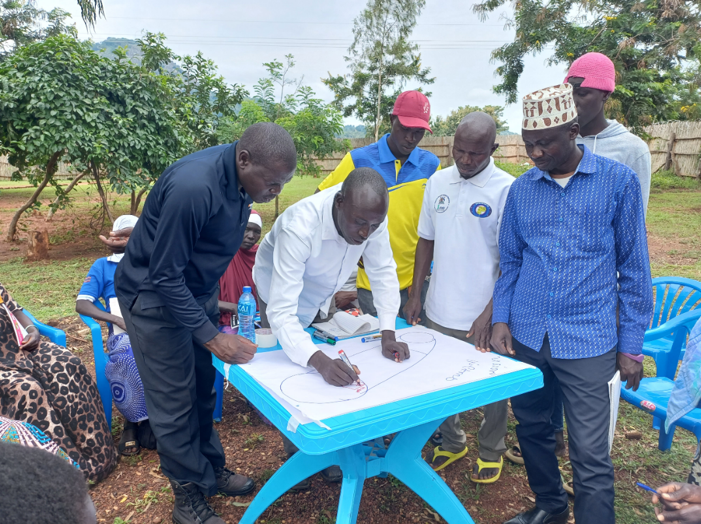
What if change started from the potential of a place, not its problems? Collaborate to Regenerate (C2R) uses storytelling, role-play and local wisdom to help communities see their landscape as a living partner. Together they create a Joint Agenda for Change that benefits people, nature and decision-makers.
Finance and Economic Viability
Who pays for regeneration, and how can it pay off? This theme explores ways to finance regenerative and inclusive innovations, from village savings groups to start-up incubation. It also asks how FSIPs can stay financially viable over time. Evidence is still being collected.
Monitoring, Evaluation and Learning (MEL)
How do we know if change is working, and for whom? We combine tested indicators with community-led monitoring and stories of change. That includes tracking whether nature itself benefits. Communities help design the metrics, and the metrics change as we learn.
Collaborate to Regenerate
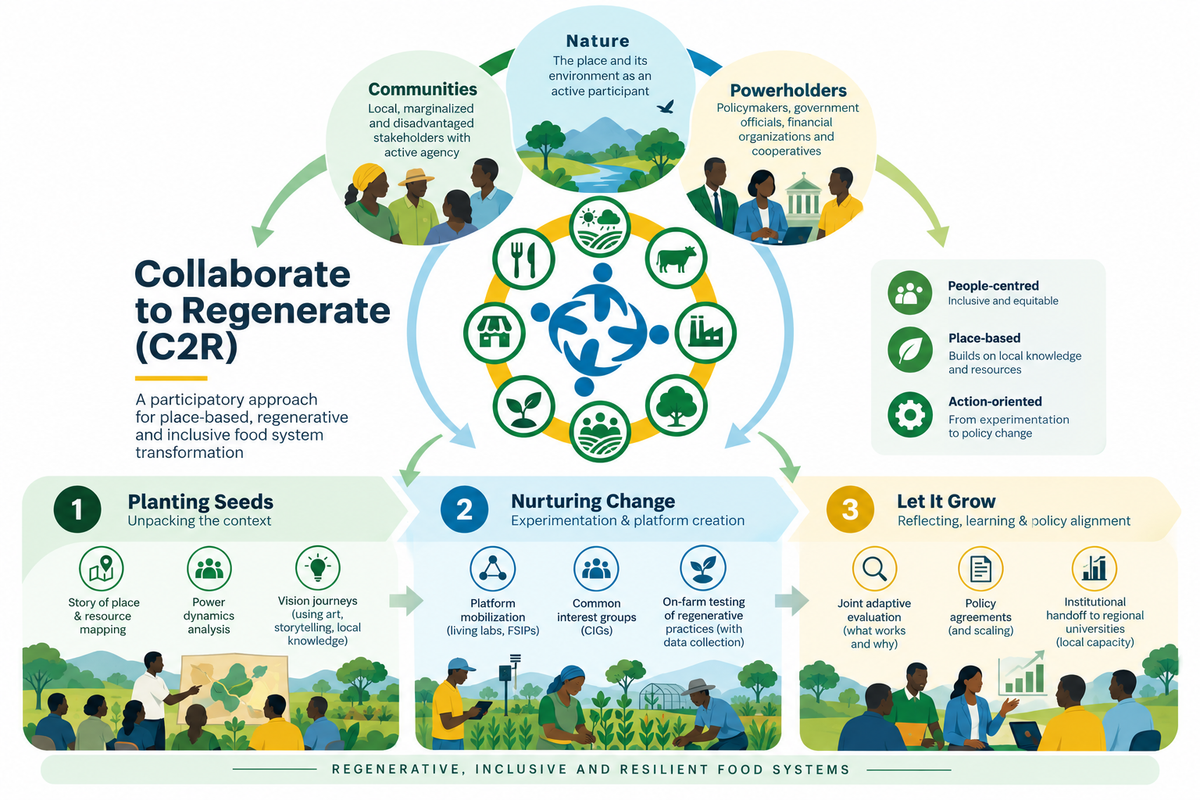
Collaborate to Regenerate (C2R) is a participatory, place-based approach that brings together communities, decision-makers, researchers, and nature to co-create regenerative and inclusive food systems.
At its heart, C2R recognizes that meaningful transformation begins with local knowledge, shared visions, and collective action. Through three interconnected phases—Planting Seeds, Nurturing Change, and Let It Grow—stakeholders jointly explore challenges and opportunities, experiment with locally relevant innovations, and translate lessons into lasting practices and policies.
By connecting diverse perspectives and empowering local actors, C2R fosters collaboration, continuous learning, and locally owned solutions for more resilient and sustainable food systems.
Meet the team
Egerton University
- prof. B. (Bebe) Bockline Omedo

- TCO (Tom) Owino

- P (Pauline) Murage
- D (Dennis) Kigiri

- dr. DO (Dickson) Okello

- dr. JM (Japhet) Muthamia

Jimma University
- Gezahegn Berecha Yadessa

- Martha Hailemariam

- Wakuma Bayissa Hundessa

Muni University
- Robert Kajobe

- Robert Ochago

- Experito Muyanja Kabuga

- Philip Isaac Omwene

- Richard Malingumu

- Sandra Langi

- Alfred Alumai

Stichting Wageningen Research-Ethiopia
- dr. T (Tewodros) Tefera

- TT(Tilaye) Deneke

- Martha Zwedie Robele
- prof. YG (Yihenew) Selassi

Wageningen University & Research
- dr. ing. J (Jochen) Froebrich

- TB (Thies) Reemer, MSc

- dr. SM (Sinead) O'Keeffe

- dr. MGR (Marianna) Siegmund-Schultze

- dr. CF (Carlos) Brazao Vieira Alho

- ir. M (Marijn) Gülpen

- EO (Elisabeth) Obeng, MSc

- dr.ir. MWC (Marijke) Dijkshoorn-Dekker